
.png)


Close
.svg)


Twenty-plus years ago, when I joined the mortgage industry, I strived to become a top producer. Whatever role I took on, from post-closing to secondary marketing, I wanted to be the very best. But as I rose from individual contributor positions into leadership, my definition of being a top producer changed. My primary goal was not to rise to the highest spot on the leader board anymore. Instead, I wanted my team members to do so.
I’d gradually shifted into the role of a servant leader—where an executive “shares power, puts the needs of others first and helps people develop and perform as highly as possible,” according to the Robert K. Greenleaf Center for Servant Leadership.
That does not mean I lost my competitive streak. Today, I co-lead correspondent sales with one of my best friends at Deephaven Mortgage, and we have a loving and fierce rivalry. I am constantly thinking of ways my team can outperform his team, and he does the same.
I won’t divulge who is winning more this year, as I don’t want to jinx our team’s stellar track record (hint, hint). What I will tell you is that servant leadership has been fundamental to our winning streak. I leverage a few other influence-building habits so my team can continue to rise, and I also prioritize self-care. After all, I need extra energy to drive my team over the finish line first.
From servant leadership to setting personal boundaries, here’s what works best for me.
Let people thrive their way: Micromanage me and I’ll find a new role elsewhere. So will the people I hire. I am scrupulous about bringing in collaborative, hardworking, high-energy, and ambitious people. Every day I wake up excited about helping each of them to prosper. My obligation is to discover what support they want, provide it, and then get out of their way so they can put their talents to work. Truly, I work for them.
Honor people’s need to make a difference: Whether I’m closing a major deal or watching the people I’ve mentored rise, having a significant impact fills me with joy. I want the people on my team to experience that same thrill. This has helped me overcome my biggest challenge as a leader, a hesitation to delegate. Now when team members say, “Let us help you,” I gratefully accept. I’m honoring their need to contribute to our shared success and helping them develop skills to achieve even bigger wins.
Maintain teams’ confidence in a limitless future: Great salespeople want to know their growth potential is limitless, and my corporate influence is key to that. I need strong, positive relationships with my fellow leaders in order to maintain their confidence and respect. Luckily, that’s easy. Many of us have worked together for several years, and we’re a tight-knight group.
Still, in a workplace where everyone cares about success, disagreements are bound to happen. When we sense problems brewing, my fellow leaders and I sit down and try to solve them without escalating any issues to our bosses. This further strengthens our relationships and prevents any hostilities from trickling down to our teams.
I’m also a big champion of workplace personality tests. They provide invaluable insights on people’s hardwiring and communication preferences. Years ago, I completed one of these assessments with some of my fellow leaders, and we shared our results. I still rely on that data today.
Become a smart email manager: Who wants a frazzled leader? Data from a recent BambooHR survey indicates that bad managers are “the #1 turnover driver, even when people like their job.” I treasure my talented team and would be upset if I repeatedly lost focus or patience with them because I was fatigued or burned out.
One of my biggest strategies to avoid these problems is to protect my time. Smart email management is a lifesaver. I look at my phone constantly, but I’ve learned to triage messages while focusing on other priorities. For that reason, I also don’t wear a smartwatch.
Being immediately available by email or text, 24/7, just isn’t sustainable. Even hardworking sales superstars need to find balance.
I show up, in person or virtually, as my best self because of this boundary setting, and that inspires and energizes my team, too. It gives these superstars another reason to stay and grow with us and consistently rise to the top of the leader board.
Sara Parrish, Chief Operating Officer, Incenter Lender Services , President, CampusDoor
If we’re honest with ourselves, many, maybe even most, women in financial services do not go home to relax when the workday ends. We go home to our second shifts managing households, caring for children and/or aging parents, and generally holding together the logistics of a life that doesn’t pause because the markets closed. We do this after spending cognitive energy on dynamics that our male colleagues don’t even have to think about. And then we do it again the next day. Excellently, I might add.
I’m not writing to the women who have it all figured out; rather, I’m writing to the women who dream about what’s possible when we stop trying to succeed on terms that weren’t built for our realities and start building influence, driving performance, and protecting our time and energy.
Whether you’re navigating the complexities of operations, wrangling capital markets, spearheading product development, or anything else in the crazy world of mortgage, the mechanics of sustainable leadership are the same. It’s not about being the loudest voice or working the longest hours. We all know if it were, the leadership tables would be stacked with us by now. It’s about being the clearest thinker, the most trusted partner, and the most intentional architect of your own time. Here’s how I do all three, without pretending it's easier than it is:
Many leaders, especially while they’re still growing, think influence is built on a stage, a boardroom, or in front of a huge group. In my experience, this is only half the picture.
The other half happens in a hallway conversation, a well-timed email, or connecting on a personal level with a colleague whose work intersects with yours in ways you haven’t mapped yet. For women in mortgage, this is both an advantage and a discipline. Research consistently shows that women tend to build broader, more diverse networks than their male counterparts and our networks tend to be webs rather than ladders. This breadth is a competitive asset, and our challenge is to activate it intentionally.
Female leaders are often coached to self-promote more. While this is well-intentioned advice and not entirely wrong, it misses something I’ve found to be critically important: the most effective self-promotion doesn’t feel like promotion at all. It feels like clarity.
High-performing women learn to translate their work into language their organizations care about, and they build the habit of making their impact visible in real time using the metrics that matter the most to the people making decisions about their careers. It’s not about ego, but about signal versus noise. In the complex organizations where most of us spend our time, the woman who closes a difficult loan, launches a feature ahead of schedule, or reduces her team’s processing errors by 30 percent owes it to herself and her team to make sure that work is seen.
Despite what we often read, the most common form of professional self-sabotage I see among my peers is not imposter syndrome or failure to negotiate. It’s the slow, daily erosion of time and energy through the accumulation of small yeses. We say yes to the meeting that could have been an email, yes to being helpful in ways that do not serve the organization’s actual priorities (or yours!), yes, yes, yes. The cost of a misplaced yes is enormous, and the payment is our having to continue our work in a depleted state.
This isn’t about becoming completely unavailable or guarding our calendars with hostility, but it is about being as rigorous about what we take on as we are about our execution. Saying no to the wrong things is how you say yes to the right things.
Influence, performance, and time are not competing priorities. When we understand them correctly, they are mutually reinforcing. The clearer we are about our time, the better our work becomes. The better our work becomes, the more authentic our influence. The more authentic our influence, the more we attract the kind of opportunities, partnerships, and environments that make sustainable performance possible. None of this is easy, but we know what we’re capable of.
Neena Vlamis, CEO, A and N Mortgage Services, Inc.
In the mortgage industry, there’s a familiar path for high achievers: you excel, you produce, and you build a reputation on the strength of your own pipeline. But what happens when the drive that made you a top producer compels you to lead? This question has defined my career. For many ambitious women in mortgage, the greatest challenge isn’t closing a difficult loan; it’s learning how to transition from being the star player to coaching the entire team to victory. It requires a fundamental shift in mindset, strategy, and even identity. How do you build an enterprise, inspire a team, and drive collective performance while ensuring the skills that got you here don’t get lost? More importantly, how do you do it all without sacrificing your sanity and your time? This is the tightrope walk of the producer-leader, and I’m here to share how I learned to navigate it.
My journey began where many of yours likely did: focused on origination. I thrived on the hustle, the satisfaction of helping families secure their homes, and the direct correlation between effort and results. For years, my identity was synonymous with my production numbers. Yet, a persistent vision kept pulling at me—a desire not just to build my own book of business, but to build a company with a distinct culture and purpose. That vision became A and N Mortgage, a 100% women-owned firm I founded to create a different kind of workplace. The transition was abrupt. Overnight, I was no longer just a producer; I was the CEO, head of HR, chief marketing officer, and lead IT support, all while still originating loans to keep the lights on. It was in that crucible of wearing every hat that I was forced to evolve from a doer into a leader. A shift from personal production to building a platform for others to produce.
Moving from producer to leader meant redefining influence. As an originator, my influence was transactional and tied to individual results. As a CEO, I learned true influence is built on empowerment, not just authority. My leadership philosophy is simple: lead from the front by setting a standard of excellence but empower your team to meet and exceed it on their own terms. This means investing heavily in mentorship. I see my primary role as a coach, helping my team members develop their skills, build their own brands, and achieve their personal goals. Influence in leadership doesn't come from being the best originator in the room; it comes from creating a room full of the best originators. It is earned through credibility, demonstrated by staying current in our craft; visibility, by representing our team in the wider industry; and authenticity, by leading with transparency and a genuine commitment to their success.
One of the biggest anxieties for a top producer stepping into leadership is the fear that overall production will drop if they step back. The solution isn't to work harder; it's to work smarter by creating systems that scale your excellence. At A and N Mortgage, we invested early in building robust, repeatable processes for every stage of the loan lifecycle. This operational backbone ensures quality and efficiency, regardless of who is managing the file. Performance is guided by clear metrics that go beyond volume; we track client satisfaction scores, turnaround times, and file quality with equal intensity. This data empowers our team with objective feedback and keeps everyone aligned on our core mission. However, systems and metrics are only effective within a strong culture. We hire for attitude and ambition, creating a collaborative environment where success is celebrated collectively. Delegation becomes an act of trust, not a loss of control, because you have the right people and the right framework in place to support them.
As producers, our instinct is to guard our time for revenue-generating activities. As leaders, your most valuable asset is still your time, but its highest and best use changes. Protecting it requires ruthless boundary-setting. I learned to time-block my calendar, dedicating specific windows for strategic planning, team coaching, and business development - and treating those appointments with the same sanctity as a client meeting. The other critical component is delegation, which is an art form for any recovering top producer. It’s not about offloading tasks you dislike; it’s about strategically empowering your team with responsibilities that will grow their skills and confidence. Letting go of a file you know you could close perfectly is difficult, but it is the only path to building a scalable, successful enterprise.
The proof of this philosophy is in the results. When I intentionally shifted my focus from personal production to building systems and coaching my team, our key metrics improved dramatically. For example, after implementing a clear delegation framework and empowering our loan officers with more autonomy, our firm’s overall loan volume increased by 30% in one year, while my personal production accounted for a smaller, more strategic portion of that total. More importantly, our client satisfaction scores remained above 95%, proving empowering the team elevates quality rather than sacrificing it.
If you are a woman in mortgage wrestling with this transition, my advice is to start small but be intentional. Identify one core operational task this week that you can document and delegate to a trusted team member. Begin to map out what your leadership philosophy is, separate from your production goals. The journey from producer to leader is not a demotion from the work you love; it is an expansion of your influence and your ability to create lasting impact.

THIS IS AN ADVERTISEMENT. This is not a commitment to lend. A and N Mortgage Services, Inc. 1945 N. Elston Ave. Chicago, IL 60642 p: 773.305.LOAN (5626) ANmtg.com NMLS No. 19291 Serving AL, AZ, CA, CO, FL, IA, IL, IN, KS, MA, MI, MN, MT, NC, OH, SC, TN, TX, WA, WI. California: Licensed by the California Department of Financial Protection and Innovation under the California Residential Mortgage Lending Act. Colorado: Regulated by the Division of Real Estate. Illinois Residential Mortgage Licensee. IL MB.0006638. Texas Recovery Fund Notice. TX- SML Approved. For licensing information and for Texas consumers to file a complaint, go to: www.anmtg.com/licensing/ and www.nmlsconsumeraccess.org. Some restrictions may apply. Programs subject to change without notice. Offer of credit subject to credit approval. Neena Vlamis NMLS No 37370
Shelly Griffin is Senior Vice President, Client Development, at Deephaven Mortgage.


Twenty-plus years ago, when I joined the mortgage industry, I strived to become a top producer. Whatever role I took on, from post-closing to secondary marketing, I wanted to be the very best. But as I rose from individual contributor positions into leadership, my definition of being a top producer changed. My primary goal was not to rise to the highest spot on the leader board anymore. Instead, I wanted my team members to do so.
I’d gradually shifted into the role of a servant leader—where an executive “shares power, puts the needs of others first and helps people develop and perform as highly as possible,” according to the Robert K. Greenleaf Center for Servant Leadership.
That does not mean I lost my competitive streak. Today, I co-lead correspondent sales with one of my best friends at Deephaven Mortgage, and we have a loving and fierce rivalry. I am constantly thinking of ways my team can outperform his team, and he does the same.
I won’t divulge who is winning more this year, as I don’t want to jinx our team’s stellar track record (hint, hint). What I will tell you is that servant leadership has been fundamental to our winning streak. I leverage a few other influence-building habits so my team can continue to rise, and I also prioritize self-care. After all, I need extra energy to drive my team over the finish line first.
From servant leadership to setting personal boundaries, here’s what works best for me.
Let people thrive their way: Micromanage me and I’ll find a new role elsewhere. So will the people I hire. I am scrupulous about bringing in collaborative, hardworking, high-energy, and ambitious people. Every day I wake up excited about helping each of them to prosper. My obligation is to discover what support they want, provide it, and then get out of their way so they can put their talents to work. Truly, I work for them.
Honor people’s need to make a difference: Whether I’m closing a major deal or watching the people I’ve mentored rise, having a significant impact fills me with joy. I want the people on my team to experience that same thrill. This has helped me overcome my biggest challenge as a leader, a hesitation to delegate. Now when team members say, “Let us help you,” I gratefully accept. I’m honoring their need to contribute to our shared success and helping them develop skills to achieve even bigger wins.
Maintain teams’ confidence in a limitless future: Great salespeople want to know their growth potential is limitless, and my corporate influence is key to that. I need strong, positive relationships with my fellow leaders in order to maintain their confidence and respect. Luckily, that’s easy. Many of us have worked together for several years, and we’re a tight-knight group.
Still, in a workplace where everyone cares about success, disagreements are bound to happen. When we sense problems brewing, my fellow leaders and I sit down and try to solve them without escalating any issues to our bosses. This further strengthens our relationships and prevents any hostilities from trickling down to our teams.
I’m also a big champion of workplace personality tests. They provide invaluable insights on people’s hardwiring and communication preferences. Years ago, I completed one of these assessments with some of my fellow leaders, and we shared our results. I still rely on that data today.
Become a smart email manager: Who wants a frazzled leader? Data from a recent BambooHR survey indicates that bad managers are “the #1 turnover driver, even when people like their job.” I treasure my talented team and would be upset if I repeatedly lost focus or patience with them because I was fatigued or burned out.
One of my biggest strategies to avoid these problems is to protect my time. Smart email management is a lifesaver. I look at my phone constantly, but I’ve learned to triage messages while focusing on other priorities. For that reason, I also don’t wear a smartwatch.
Being immediately available by email or text, 24/7, just isn’t sustainable. Even hardworking sales superstars need to find balance.
I show up, in person or virtually, as my best self because of this boundary setting, and that inspires and energizes my team, too. It gives these superstars another reason to stay and grow with us and consistently rise to the top of the leader board.
Sara Parrish, Chief Operating Officer, Incenter Lender Services , President, CampusDoor
If we’re honest with ourselves, many, maybe even most, women in financial services do not go home to relax when the workday ends. We go home to our second shifts managing households, caring for children and/or aging parents, and generally holding together the logistics of a life that doesn’t pause because the markets closed. We do this after spending cognitive energy on dynamics that our male colleagues don’t even have to think about. And then we do it again the next day. Excellently, I might add.
I’m not writing to the women who have it all figured out; rather, I’m writing to the women who dream about what’s possible when we stop trying to succeed on terms that weren’t built for our realities and start building influence, driving performance, and protecting our time and energy.
Whether you’re navigating the complexities of operations, wrangling capital markets, spearheading product development, or anything else in the crazy world of mortgage, the mechanics of sustainable leadership are the same. It’s not about being the loudest voice or working the longest hours. We all know if it were, the leadership tables would be stacked with us by now. It’s about being the clearest thinker, the most trusted partner, and the most intentional architect of your own time. Here’s how I do all three, without pretending it's easier than it is:
Many leaders, especially while they’re still growing, think influence is built on a stage, a boardroom, or in front of a huge group. In my experience, this is only half the picture.
The other half happens in a hallway conversation, a well-timed email, or connecting on a personal level with a colleague whose work intersects with yours in ways you haven’t mapped yet. For women in mortgage, this is both an advantage and a discipline. Research consistently shows that women tend to build broader, more diverse networks than their male counterparts and our networks tend to be webs rather than ladders. This breadth is a competitive asset, and our challenge is to activate it intentionally.
Female leaders are often coached to self-promote more. While this is well-intentioned advice and not entirely wrong, it misses something I’ve found to be critically important: the most effective self-promotion doesn’t feel like promotion at all. It feels like clarity.
High-performing women learn to translate their work into language their organizations care about, and they build the habit of making their impact visible in real time using the metrics that matter the most to the people making decisions about their careers. It’s not about ego, but about signal versus noise. In the complex organizations where most of us spend our time, the woman who closes a difficult loan, launches a feature ahead of schedule, or reduces her team’s processing errors by 30 percent owes it to herself and her team to make sure that work is seen.
Despite what we often read, the most common form of professional self-sabotage I see among my peers is not imposter syndrome or failure to negotiate. It’s the slow, daily erosion of time and energy through the accumulation of small yeses. We say yes to the meeting that could have been an email, yes to being helpful in ways that do not serve the organization’s actual priorities (or yours!), yes, yes, yes. The cost of a misplaced yes is enormous, and the payment is our having to continue our work in a depleted state.
This isn’t about becoming completely unavailable or guarding our calendars with hostility, but it is about being as rigorous about what we take on as we are about our execution. Saying no to the wrong things is how you say yes to the right things.
Influence, performance, and time are not competing priorities. When we understand them correctly, they are mutually reinforcing. The clearer we are about our time, the better our work becomes. The better our work becomes, the more authentic our influence. The more authentic our influence, the more we attract the kind of opportunities, partnerships, and environments that make sustainable performance possible. None of this is easy, but we know what we’re capable of.
Neena Vlamis, CEO, A and N Mortgage Services, Inc.
In the mortgage industry, there’s a familiar path for high achievers: you excel, you produce, and you build a reputation on the strength of your own pipeline. But what happens when the drive that made you a top producer compels you to lead? This question has defined my career. For many ambitious women in mortgage, the greatest challenge isn’t closing a difficult loan; it’s learning how to transition from being the star player to coaching the entire team to victory. It requires a fundamental shift in mindset, strategy, and even identity. How do you build an enterprise, inspire a team, and drive collective performance while ensuring the skills that got you here don’t get lost? More importantly, how do you do it all without sacrificing your sanity and your time? This is the tightrope walk of the producer-leader, and I’m here to share how I learned to navigate it.
My journey began where many of yours likely did: focused on origination. I thrived on the hustle, the satisfaction of helping families secure their homes, and the direct correlation between effort and results. For years, my identity was synonymous with my production numbers. Yet, a persistent vision kept pulling at me—a desire not just to build my own book of business, but to build a company with a distinct culture and purpose. That vision became A and N Mortgage, a 100% women-owned firm I founded to create a different kind of workplace. The transition was abrupt. Overnight, I was no longer just a producer; I was the CEO, head of HR, chief marketing officer, and lead IT support, all while still originating loans to keep the lights on. It was in that crucible of wearing every hat that I was forced to evolve from a doer into a leader. A shift from personal production to building a platform for others to produce.
Moving from producer to leader meant redefining influence. As an originator, my influence was transactional and tied to individual results. As a CEO, I learned true influence is built on empowerment, not just authority. My leadership philosophy is simple: lead from the front by setting a standard of excellence but empower your team to meet and exceed it on their own terms. This means investing heavily in mentorship. I see my primary role as a coach, helping my team members develop their skills, build their own brands, and achieve their personal goals. Influence in leadership doesn't come from being the best originator in the room; it comes from creating a room full of the best originators. It is earned through credibility, demonstrated by staying current in our craft; visibility, by representing our team in the wider industry; and authenticity, by leading with transparency and a genuine commitment to their success.
One of the biggest anxieties for a top producer stepping into leadership is the fear that overall production will drop if they step back. The solution isn't to work harder; it's to work smarter by creating systems that scale your excellence. At A and N Mortgage, we invested early in building robust, repeatable processes for every stage of the loan lifecycle. This operational backbone ensures quality and efficiency, regardless of who is managing the file. Performance is guided by clear metrics that go beyond volume; we track client satisfaction scores, turnaround times, and file quality with equal intensity. This data empowers our team with objective feedback and keeps everyone aligned on our core mission. However, systems and metrics are only effective within a strong culture. We hire for attitude and ambition, creating a collaborative environment where success is celebrated collectively. Delegation becomes an act of trust, not a loss of control, because you have the right people and the right framework in place to support them.
As producers, our instinct is to guard our time for revenue-generating activities. As leaders, your most valuable asset is still your time, but its highest and best use changes. Protecting it requires ruthless boundary-setting. I learned to time-block my calendar, dedicating specific windows for strategic planning, team coaching, and business development - and treating those appointments with the same sanctity as a client meeting. The other critical component is delegation, which is an art form for any recovering top producer. It’s not about offloading tasks you dislike; it’s about strategically empowering your team with responsibilities that will grow their skills and confidence. Letting go of a file you know you could close perfectly is difficult, but it is the only path to building a scalable, successful enterprise.
The proof of this philosophy is in the results. When I intentionally shifted my focus from personal production to building systems and coaching my team, our key metrics improved dramatically. For example, after implementing a clear delegation framework and empowering our loan officers with more autonomy, our firm’s overall loan volume increased by 30% in one year, while my personal production accounted for a smaller, more strategic portion of that total. More importantly, our client satisfaction scores remained above 95%, proving empowering the team elevates quality rather than sacrificing it.
If you are a woman in mortgage wrestling with this transition, my advice is to start small but be intentional. Identify one core operational task this week that you can document and delegate to a trusted team member. Begin to map out what your leadership philosophy is, separate from your production goals. The journey from producer to leader is not a demotion from the work you love; it is an expansion of your influence and your ability to create lasting impact.
THIS IS AN ADVERTISEMENT. This is not a commitment to lend. A and N Mortgage Services, Inc. 1945 N. Elston Ave. Chicago, IL 60642 p: 773.305.LOAN (5626) ANmtg.com NMLS No. 19291 Serving AL, AZ, CA, CO, FL, IA, IL, IN, KS, MA, MI, MN, MT, NC, OH, SC, TN, TX, WA, WI. California: Licensed by the California Department of Financial Protection and Innovation under the California Residential Mortgage Lending Act. Colorado: Regulated by the Division of Real Estate. Illinois Residential Mortgage Licensee. IL MB.0006638. Texas Recovery Fund Notice. TX- SML Approved. For licensing information and for Texas consumers to file a complaint, go to: www.anmtg.com/licensing/ and www.nmlsconsumeraccess.org. Some restrictions may apply. Programs subject to change without notice. Offer of credit subject to credit approval. Neena Vlamis NMLS No 37370
Shelly Griffin is Senior Vice President, Client Development, at Deephaven Mortgage.
Twenty-plus years ago, when I joined the mortgage industry, I strived to become a top producer. Whatever role I took on, from post-closing to secondary marketing, I wanted to be the very best. But as I rose from individual contributor positions into leadership, my definition of being a top producer changed. My primary goal was not to rise to the highest spot on the leader board anymore. Instead, I wanted my team members to do so.
I’d gradually shifted into the role of a servant leader—where an executive “shares power, puts the needs of others first and helps people develop and perform as highly as possible,” according to the Robert K. Greenleaf Center for Servant Leadership.
That does not mean I lost my competitive streak. Today, I co-lead correspondent sales with one of my best friends at Deephaven Mortgage, and we have a loving and fierce rivalry. I am constantly thinking of ways my team can outperform his team, and he does the same.
I won’t divulge who is winning more this year, as I don’t want to jinx our team’s stellar track record (hint, hint). What I will tell you is that servant leadership has been fundamental to our winning streak. I leverage a few other influence-building habits so my team can continue to rise, and I also prioritize self-care. After all, I need extra energy to drive my team over the finish line first.
From servant leadership to setting personal boundaries, here’s what works best for me.
Let people thrive their way: Micromanage me and I’ll find a new role elsewhere. So will the people I hire. I am scrupulous about bringing in collaborative, hardworking, high-energy, and ambitious people. Every day I wake up excited about helping each of them to prosper. My obligation is to discover what support they want, provide it, and then get out of their way so they can put their talents to work. Truly, I work for them.
Honor people’s need to make a difference: Whether I’m closing a major deal or watching the people I’ve mentored rise, having a significant impact fills me with joy. I want the people on my team to experience that same thrill. This has helped me overcome my biggest challenge as a leader, a hesitation to delegate. Now when team members say, “Let us help you,” I gratefully accept. I’m honoring their need to contribute to our shared success and helping them develop skills to achieve even bigger wins.
Maintain teams’ confidence in a limitless future: Great salespeople want to know their growth potential is limitless, and my corporate influence is key to that. I need strong, positive relationships with my fellow leaders in order to maintain their confidence and respect. Luckily, that’s easy. Many of us have worked together for several years, and we’re a tight-knight group.
Still, in a workplace where everyone cares about success, disagreements are bound to happen. When we sense problems brewing, my fellow leaders and I sit down and try to solve them without escalating any issues to our bosses. This further strengthens our relationships and prevents any hostilities from trickling down to our teams.
I’m also a big champion of workplace personality tests. They provide invaluable insights on people’s hardwiring and communication preferences. Years ago, I completed one of these assessments with some of my fellow leaders, and we shared our results. I still rely on that data today.
Become a smart email manager: Who wants a frazzled leader? Data from a recent BambooHR survey indicates that bad managers are “the #1 turnover driver, even when people like their job.” I treasure my talented team and would be upset if I repeatedly lost focus or patience with them because I was fatigued or burned out.
One of my biggest strategies to avoid these problems is to protect my time. Smart email management is a lifesaver. I look at my phone constantly, but I’ve learned to triage messages while focusing on other priorities. For that reason, I also don’t wear a smartwatch.
Being immediately available by email or text, 24/7, just isn’t sustainable. Even hardworking sales superstars need to find balance.
I show up, in person or virtually, as my best self because of this boundary setting, and that inspires and energizes my team, too. It gives these superstars another reason to stay and grow with us and consistently rise to the top of the leader board.
Sara Parrish, Chief Operating Officer, Incenter Lender Services , President, CampusDoor
If we’re honest with ourselves, many, maybe even most, women in financial services do not go home to relax when the workday ends. We go home to our second shifts managing households, caring for children and/or aging parents, and generally holding together the logistics of a life that doesn’t pause because the markets closed. We do this after spending cognitive energy on dynamics that our male colleagues don’t even have to think about. And then we do it again the next day. Excellently, I might add.
I’m not writing to the women who have it all figured out; rather, I’m writing to the women who dream about what’s possible when we stop trying to succeed on terms that weren’t built for our realities and start building influence, driving performance, and protecting our time and energy.
Whether you’re navigating the complexities of operations, wrangling capital markets, spearheading product development, or anything else in the crazy world of mortgage, the mechanics of sustainable leadership are the same. It’s not about being the loudest voice or working the longest hours. We all know if it were, the leadership tables would be stacked with us by now. It’s about being the clearest thinker, the most trusted partner, and the most intentional architect of your own time. Here’s how I do all three, without pretending it's easier than it is:
Many leaders, especially while they’re still growing, think influence is built on a stage, a boardroom, or in front of a huge group. In my experience, this is only half the picture.
The other half happens in a hallway conversation, a well-timed email, or connecting on a personal level with a colleague whose work intersects with yours in ways you haven’t mapped yet. For women in mortgage, this is both an advantage and a discipline. Research consistently shows that women tend to build broader, more diverse networks than their male counterparts and our networks tend to be webs rather than ladders. This breadth is a competitive asset, and our challenge is to activate it intentionally.
Female leaders are often coached to self-promote more. While this is well-intentioned advice and not entirely wrong, it misses something I’ve found to be critically important: the most effective self-promotion doesn’t feel like promotion at all. It feels like clarity.
High-performing women learn to translate their work into language their organizations care about, and they build the habit of making their impact visible in real time using the metrics that matter the most to the people making decisions about their careers. It’s not about ego, but about signal versus noise. In the complex organizations where most of us spend our time, the woman who closes a difficult loan, launches a feature ahead of schedule, or reduces her team’s processing errors by 30 percent owes it to herself and her team to make sure that work is seen.
Despite what we often read, the most common form of professional self-sabotage I see among my peers is not imposter syndrome or failure to negotiate. It’s the slow, daily erosion of time and energy through the accumulation of small yeses. We say yes to the meeting that could have been an email, yes to being helpful in ways that do not serve the organization’s actual priorities (or yours!), yes, yes, yes. The cost of a misplaced yes is enormous, and the payment is our having to continue our work in a depleted state.
This isn’t about becoming completely unavailable or guarding our calendars with hostility, but it is about being as rigorous about what we take on as we are about our execution. Saying no to the wrong things is how you say yes to the right things.
Influence, performance, and time are not competing priorities. When we understand them correctly, they are mutually reinforcing. The clearer we are about our time, the better our work becomes. The better our work becomes, the more authentic our influence. The more authentic our influence, the more we attract the kind of opportunities, partnerships, and environments that make sustainable performance possible. None of this is easy, but we know what we’re capable of.
Neena Vlamis, CEO, A and N Mortgage Services, Inc.
In the mortgage industry, there’s a familiar path for high achievers: you excel, you produce, and you build a reputation on the strength of your own pipeline. But what happens when the drive that made you a top producer compels you to lead? This question has defined my career. For many ambitious women in mortgage, the greatest challenge isn’t closing a difficult loan; it’s learning how to transition from being the star player to coaching the entire team to victory. It requires a fundamental shift in mindset, strategy, and even identity. How do you build an enterprise, inspire a team, and drive collective performance while ensuring the skills that got you here don’t get lost? More importantly, how do you do it all without sacrificing your sanity and your time? This is the tightrope walk of the producer-leader, and I’m here to share how I learned to navigate it.
My journey began where many of yours likely did: focused on origination. I thrived on the hustle, the satisfaction of helping families secure their homes, and the direct correlation between effort and results. For years, my identity was synonymous with my production numbers. Yet, a persistent vision kept pulling at me—a desire not just to build my own book of business, but to build a company with a distinct culture and purpose. That vision became A and N Mortgage, a 100% women-owned firm I founded to create a different kind of workplace. The transition was abrupt. Overnight, I was no longer just a producer; I was the CEO, head of HR, chief marketing officer, and lead IT support, all while still originating loans to keep the lights on. It was in that crucible of wearing every hat that I was forced to evolve from a doer into a leader. A shift from personal production to building a platform for others to produce.
Moving from producer to leader meant redefining influence. As an originator, my influence was transactional and tied to individual results. As a CEO, I learned true influence is built on empowerment, not just authority. My leadership philosophy is simple: lead from the front by setting a standard of excellence but empower your team to meet and exceed it on their own terms. This means investing heavily in mentorship. I see my primary role as a coach, helping my team members develop their skills, build their own brands, and achieve their personal goals. Influence in leadership doesn't come from being the best originator in the room; it comes from creating a room full of the best originators. It is earned through credibility, demonstrated by staying current in our craft; visibility, by representing our team in the wider industry; and authenticity, by leading with transparency and a genuine commitment to their success.
One of the biggest anxieties for a top producer stepping into leadership is the fear that overall production will drop if they step back. The solution isn't to work harder; it's to work smarter by creating systems that scale your excellence. At A and N Mortgage, we invested early in building robust, repeatable processes for every stage of the loan lifecycle. This operational backbone ensures quality and efficiency, regardless of who is managing the file. Performance is guided by clear metrics that go beyond volume; we track client satisfaction scores, turnaround times, and file quality with equal intensity. This data empowers our team with objective feedback and keeps everyone aligned on our core mission. However, systems and metrics are only effective within a strong culture. We hire for attitude and ambition, creating a collaborative environment where success is celebrated collectively. Delegation becomes an act of trust, not a loss of control, because you have the right people and the right framework in place to support them.
As producers, our instinct is to guard our time for revenue-generating activities. As leaders, your most valuable asset is still your time, but its highest and best use changes. Protecting it requires ruthless boundary-setting. I learned to time-block my calendar, dedicating specific windows for strategic planning, team coaching, and business development - and treating those appointments with the same sanctity as a client meeting. The other critical component is delegation, which is an art form for any recovering top producer. It’s not about offloading tasks you dislike; it’s about strategically empowering your team with responsibilities that will grow their skills and confidence. Letting go of a file you know you could close perfectly is difficult, but it is the only path to building a scalable, successful enterprise.
The proof of this philosophy is in the results. When I intentionally shifted my focus from personal production to building systems and coaching my team, our key metrics improved dramatically. For example, after implementing a clear delegation framework and empowering our loan officers with more autonomy, our firm’s overall loan volume increased by 30% in one year, while my personal production accounted for a smaller, more strategic portion of that total. More importantly, our client satisfaction scores remained above 95%, proving empowering the team elevates quality rather than sacrificing it.
If you are a woman in mortgage wrestling with this transition, my advice is to start small but be intentional. Identify one core operational task this week that you can document and delegate to a trusted team member. Begin to map out what your leadership philosophy is, separate from your production goals. The journey from producer to leader is not a demotion from the work you love; it is an expansion of your influence and your ability to create lasting impact.
THIS IS AN ADVERTISEMENT. This is not a commitment to lend. A and N Mortgage Services, Inc. 1945 N. Elston Ave. Chicago, IL 60642 p: 773.305.LOAN (5626) ANmtg.com NMLS No. 19291 Serving AL, AZ, CA, CO, FL, IA, IL, IN, KS, MA, MI, MN, MT, NC, OH, SC, TN, TX, WA, WI. California: Licensed by the California Department of Financial Protection and Innovation under the California Residential Mortgage Lending Act. Colorado: Regulated by the Division of Real Estate. Illinois Residential Mortgage Licensee. IL MB.0006638. Texas Recovery Fund Notice. TX- SML Approved. For licensing information and for Texas consumers to file a complaint, go to: www.anmtg.com/licensing/ and www.nmlsconsumeraccess.org. Some restrictions may apply. Programs subject to change without notice. Offer of credit subject to credit approval. Neena Vlamis NMLS No 37370
Shelly Griffin is Senior Vice President, Client Development, at Deephaven Mortgage.
Twenty-plus years ago, when I joined the mortgage industry, I strived to become a top producer. Whatever role I took on, from post-closing to secondary marketing, I wanted to be the very best. But as I rose from individual contributor positions into leadership, my definition of being a top producer changed. My primary goal was not to rise to the highest spot on the leader board anymore. Instead, I wanted my team members to do so.
I’d gradually shifted into the role of a servant leader—where an executive “shares power, puts the needs of others first and helps people develop and perform as highly as possible,” according to the Robert K. Greenleaf Center for Servant Leadership.
That does not mean I lost my competitive streak. Today, I co-lead correspondent sales with one of my best friends at Deephaven Mortgage, and we have a loving and fierce rivalry. I am constantly thinking of ways my team can outperform his team, and he does the same.
I won’t divulge who is winning more this year, as I don’t want to jinx our team’s stellar track record (hint, hint). What I will tell you is that servant leadership has been fundamental to our winning streak. I leverage a few other influence-building habits so my team can continue to rise, and I also prioritize self-care. After all, I need extra energy to drive my team over the finish line first.
From servant leadership to setting personal boundaries, here’s what works best for me.
Let people thrive their way: Micromanage me and I’ll find a new role elsewhere. So will the people I hire. I am scrupulous about bringing in collaborative, hardworking, high-energy, and ambitious people. Every day I wake up excited about helping each of them to prosper. My obligation is to discover what support they want, provide it, and then get out of their way so they can put their talents to work. Truly, I work for them.
Honor people’s need to make a difference: Whether I’m closing a major deal or watching the people I’ve mentored rise, having a significant impact fills me with joy. I want the people on my team to experience that same thrill. This has helped me overcome my biggest challenge as a leader, a hesitation to delegate. Now when team members say, “Let us help you,” I gratefully accept. I’m honoring their need to contribute to our shared success and helping them develop skills to achieve even bigger wins.
Maintain teams’ confidence in a limitless future: Great salespeople want to know their growth potential is limitless, and my corporate influence is key to that. I need strong, positive relationships with my fellow leaders in order to maintain their confidence and respect. Luckily, that’s easy. Many of us have worked together for several years, and we’re a tight-knight group.
Still, in a workplace where everyone cares about success, disagreements are bound to happen. When we sense problems brewing, my fellow leaders and I sit down and try to solve them without escalating any issues to our bosses. This further strengthens our relationships and prevents any hostilities from trickling down to our teams.
I’m also a big champion of workplace personality tests. They provide invaluable insights on people’s hardwiring and communication preferences. Years ago, I completed one of these assessments with some of my fellow leaders, and we shared our results. I still rely on that data today.
Become a smart email manager: Who wants a frazzled leader? Data from a recent BambooHR survey indicates that bad managers are “the #1 turnover driver, even when people like their job.” I treasure my talented team and would be upset if I repeatedly lost focus or patience with them because I was fatigued or burned out.
One of my biggest strategies to avoid these problems is to protect my time. Smart email management is a lifesaver. I look at my phone constantly, but I’ve learned to triage messages while focusing on other priorities. For that reason, I also don’t wear a smartwatch.
Being immediately available by email or text, 24/7, just isn’t sustainable. Even hardworking sales superstars need to find balance.
I show up, in person or virtually, as my best self because of this boundary setting, and that inspires and energizes my team, too. It gives these superstars another reason to stay and grow with us and consistently rise to the top of the leader board.
Sara Parrish, Chief Operating Officer, Incenter Lender Services , President, CampusDoor
If we’re honest with ourselves, many, maybe even most, women in financial services do not go home to relax when the workday ends. We go home to our second shifts managing households, caring for children and/or aging parents, and generally holding together the logistics of a life that doesn’t pause because the markets closed. We do this after spending cognitive energy on dynamics that our male colleagues don’t even have to think about. And then we do it again the next day. Excellently, I might add.
I’m not writing to the women who have it all figured out; rather, I’m writing to the women who dream about what’s possible when we stop trying to succeed on terms that weren’t built for our realities and start building influence, driving performance, and protecting our time and energy.
Whether you’re navigating the complexities of operations, wrangling capital markets, spearheading product development, or anything else in the crazy world of mortgage, the mechanics of sustainable leadership are the same. It’s not about being the loudest voice or working the longest hours. We all know if it were, the leadership tables would be stacked with us by now. It’s about being the clearest thinker, the most trusted partner, and the most intentional architect of your own time. Here’s how I do all three, without pretending it's easier than it is:
Many leaders, especially while they’re still growing, think influence is built on a stage, a boardroom, or in front of a huge group. In my experience, this is only half the picture.
The other half happens in a hallway conversation, a well-timed email, or connecting on a personal level with a colleague whose work intersects with yours in ways you haven’t mapped yet. For women in mortgage, this is both an advantage and a discipline. Research consistently shows that women tend to build broader, more diverse networks than their male counterparts and our networks tend to be webs rather than ladders. This breadth is a competitive asset, and our challenge is to activate it intentionally.
Female leaders are often coached to self-promote more. While this is well-intentioned advice and not entirely wrong, it misses something I’ve found to be critically important: the most effective self-promotion doesn’t feel like promotion at all. It feels like clarity.
High-performing women learn to translate their work into language their organizations care about, and they build the habit of making their impact visible in real time using the metrics that matter the most to the people making decisions about their careers. It’s not about ego, but about signal versus noise. In the complex organizations where most of us spend our time, the woman who closes a difficult loan, launches a feature ahead of schedule, or reduces her team’s processing errors by 30 percent owes it to herself and her team to make sure that work is seen.
Despite what we often read, the most common form of professional self-sabotage I see among my peers is not imposter syndrome or failure to negotiate. It’s the slow, daily erosion of time and energy through the accumulation of small yeses. We say yes to the meeting that could have been an email, yes to being helpful in ways that do not serve the organization’s actual priorities (or yours!), yes, yes, yes. The cost of a misplaced yes is enormous, and the payment is our having to continue our work in a depleted state.
This isn’t about becoming completely unavailable or guarding our calendars with hostility, but it is about being as rigorous about what we take on as we are about our execution. Saying no to the wrong things is how you say yes to the right things.
Influence, performance, and time are not competing priorities. When we understand them correctly, they are mutually reinforcing. The clearer we are about our time, the better our work becomes. The better our work becomes, the more authentic our influence. The more authentic our influence, the more we attract the kind of opportunities, partnerships, and environments that make sustainable performance possible. None of this is easy, but we know what we’re capable of.
Neena Vlamis, CEO, A and N Mortgage Services, Inc.
In the mortgage industry, there’s a familiar path for high achievers: you excel, you produce, and you build a reputation on the strength of your own pipeline. But what happens when the drive that made you a top producer compels you to lead? This question has defined my career. For many ambitious women in mortgage, the greatest challenge isn’t closing a difficult loan; it’s learning how to transition from being the star player to coaching the entire team to victory. It requires a fundamental shift in mindset, strategy, and even identity. How do you build an enterprise, inspire a team, and drive collective performance while ensuring the skills that got you here don’t get lost? More importantly, how do you do it all without sacrificing your sanity and your time? This is the tightrope walk of the producer-leader, and I’m here to share how I learned to navigate it.
My journey began where many of yours likely did: focused on origination. I thrived on the hustle, the satisfaction of helping families secure their homes, and the direct correlation between effort and results. For years, my identity was synonymous with my production numbers. Yet, a persistent vision kept pulling at me—a desire not just to build my own book of business, but to build a company with a distinct culture and purpose. That vision became A and N Mortgage, a 100% women-owned firm I founded to create a different kind of workplace. The transition was abrupt. Overnight, I was no longer just a producer; I was the CEO, head of HR, chief marketing officer, and lead IT support, all while still originating loans to keep the lights on. It was in that crucible of wearing every hat that I was forced to evolve from a doer into a leader. A shift from personal production to building a platform for others to produce.
Moving from producer to leader meant redefining influence. As an originator, my influence was transactional and tied to individual results. As a CEO, I learned true influence is built on empowerment, not just authority. My leadership philosophy is simple: lead from the front by setting a standard of excellence but empower your team to meet and exceed it on their own terms. This means investing heavily in mentorship. I see my primary role as a coach, helping my team members develop their skills, build their own brands, and achieve their personal goals. Influence in leadership doesn't come from being the best originator in the room; it comes from creating a room full of the best originators. It is earned through credibility, demonstrated by staying current in our craft; visibility, by representing our team in the wider industry; and authenticity, by leading with transparency and a genuine commitment to their success.
One of the biggest anxieties for a top producer stepping into leadership is the fear that overall production will drop if they step back. The solution isn't to work harder; it's to work smarter by creating systems that scale your excellence. At A and N Mortgage, we invested early in building robust, repeatable processes for every stage of the loan lifecycle. This operational backbone ensures quality and efficiency, regardless of who is managing the file. Performance is guided by clear metrics that go beyond volume; we track client satisfaction scores, turnaround times, and file quality with equal intensity. This data empowers our team with objective feedback and keeps everyone aligned on our core mission. However, systems and metrics are only effective within a strong culture. We hire for attitude and ambition, creating a collaborative environment where success is celebrated collectively. Delegation becomes an act of trust, not a loss of control, because you have the right people and the right framework in place to support them.
As producers, our instinct is to guard our time for revenue-generating activities. As leaders, your most valuable asset is still your time, but its highest and best use changes. Protecting it requires ruthless boundary-setting. I learned to time-block my calendar, dedicating specific windows for strategic planning, team coaching, and business development - and treating those appointments with the same sanctity as a client meeting. The other critical component is delegation, which is an art form for any recovering top producer. It’s not about offloading tasks you dislike; it’s about strategically empowering your team with responsibilities that will grow their skills and confidence. Letting go of a file you know you could close perfectly is difficult, but it is the only path to building a scalable, successful enterprise.
The proof of this philosophy is in the results. When I intentionally shifted my focus from personal production to building systems and coaching my team, our key metrics improved dramatically. For example, after implementing a clear delegation framework and empowering our loan officers with more autonomy, our firm’s overall loan volume increased by 30% in one year, while my personal production accounted for a smaller, more strategic portion of that total. More importantly, our client satisfaction scores remained above 95%, proving empowering the team elevates quality rather than sacrificing it.
If you are a woman in mortgage wrestling with this transition, my advice is to start small but be intentional. Identify one core operational task this week that you can document and delegate to a trusted team member. Begin to map out what your leadership philosophy is, separate from your production goals. The journey from producer to leader is not a demotion from the work you love; it is an expansion of your influence and your ability to create lasting impact.
THIS IS AN ADVERTISEMENT. This is not a commitment to lend. A and N Mortgage Services, Inc. 1945 N. Elston Ave. Chicago, IL 60642 p: 773.305.LOAN (5626) ANmtg.com NMLS No. 19291 Serving AL, AZ, CA, CO, FL, IA, IL, IN, KS, MA, MI, MN, MT, NC, OH, SC, TN, TX, WA, WI. California: Licensed by the California Department of Financial Protection and Innovation under the California Residential Mortgage Lending Act. Colorado: Regulated by the Division of Real Estate. Illinois Residential Mortgage Licensee. IL MB.0006638. Texas Recovery Fund Notice. TX- SML Approved. For licensing information and for Texas consumers to file a complaint, go to: www.anmtg.com/licensing/ and www.nmlsconsumeraccess.org. Some restrictions may apply. Programs subject to change without notice. Offer of credit subject to credit approval. Neena Vlamis NMLS No 37370
Shelly Griffin is Senior Vice President, Client Development, at Deephaven Mortgage.

MaxClass is a woman-owned company, and we're offering MWLC members 65% off your continuing education when you use our code WOMENWIN.
MaxClass is a woman-owned company, and we're offering MWLC members 65% off your continuing education. Become a member for our unique code.


Learning is a constant ever-evolving necessity in the industry


Single women are now buying more homes than single men

The new rules of mortgage brand awareness

Why women in mortgage are built to become trust architects


The unexpected turns that led Mae Mackey to the industry

Why humanity is the most valuable currency in mortgage lending

Three women leaders on why curiosity, courage, and raising your hand matter more than checking every box

How resilience, adaptability, and voice powered Elizabeth Mix’s rise in mortgage banking
.png)
Why the long way around led to clarity, growth, and a more intentional mortgage career

Strong brands don’t just differentiate — they mentor, inspire, and transform the future of mortgage

The industry keeps repeating old mistakes. Here’s how lenders can pivot, prepare, and protect profitability

A surprisingly powerful break from the chaos of grown-up life.

From Charmed to the mortgage industry

A letter from the editor
MaxClass is a woman-owned company, and we're offering MWLC members 65% off your continuing education when you use our code WOMENWIN.
MaxClass is a woman-owned company, and we're offering MWLC members 65% off your continuing education. Become a member for our unique code.
.png)


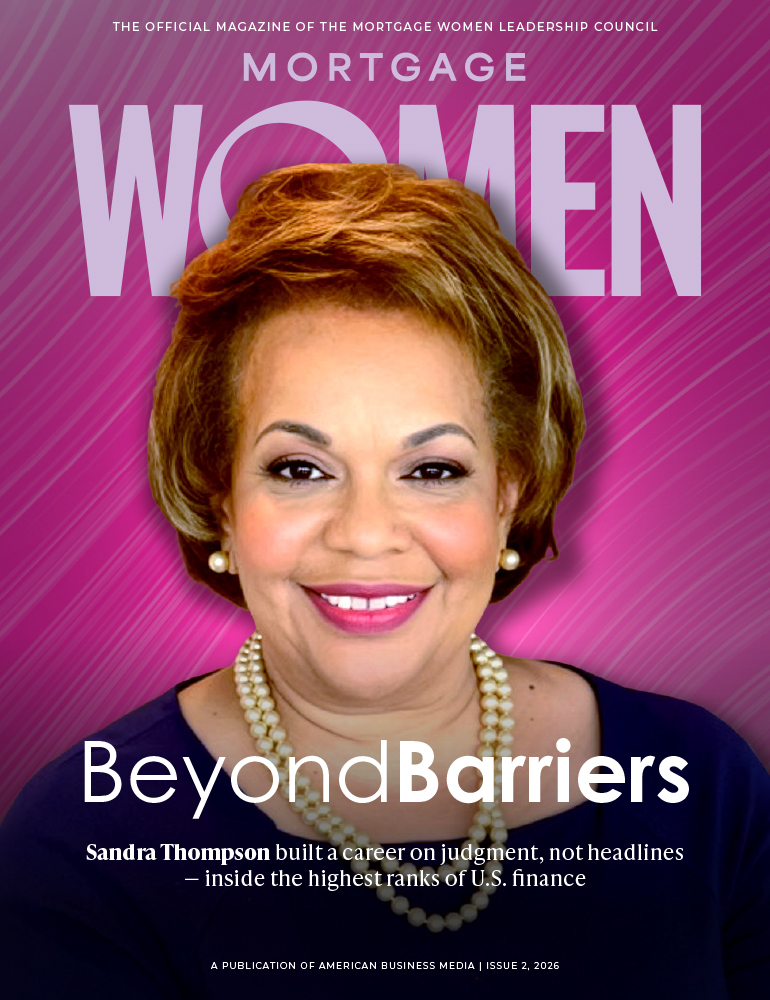
Sandra Thompson’s groundbreaking rise from bank supervision at the Federal Deposit Insurance Corporation to leading the Federal Housing Finance Agency reflects a career defined by steady leadership, sound judgment, and a refusal to let barriers dictate her path.

Integrating innovation without losing the human connection

Board members Seek Ways to Elevate and Empower More Women to Step into Their Potential

For Mosi Gatling, embracing change has never been optional — it’s been a way of life.

There’s a type of work in the mortgage industry that almost no one talks about.

A leader in the mortgage industry and “a visionary” according to her peers, Kelly Zitlow sits at the helm of a nonprofit empowering girls to master the use of power tools and take on the lost art of building with their hands.


.jpg)



.png)
.png)






.png)












.png)










.png)



Lorem ipsum dolor sit amet, consectetur adipiscing elit. Suspendisse varius enim in eros elementum tristique. Duis cursus, mi quis viverra ornare, eros dolor interdum nulla, ut commodo diam libero vitae erat. Aenean faucibus nibh et justo cursus id rutrum lorem imperdiet. Nunc ut sem vitae risus tristique posuere.
Lorem ipsum dolor sit amet, consectetur adipiscing elit. Suspendisse varius enim in eros elementum tristique. Duis cursus, mi quis viverra ornare, eros dolor interdum nulla, ut commodo diam libero vitae erat. Aenean faucibus nibh et justo cursus id rutrum lorem imperdiet. Nunc ut sem vitae risus tristique posuere.